
Artificial intelligence has become a foundational pillar of modern content strategies. What was once an experimental tool is now a daily productivity engine for marketers, writers, and SEO professionals. Among the most influential platforms available today, ChatGPT vs. Google Gemini for content marketing stands out as one of the most important comparisons for teams aiming to scale high-quality content efficiently.
As AI adoption accelerates, marketers must evaluate not just what these tools can do, but how they align with business goals, workflows, and long-term strategy. This guide explores the strengths, limitations, and ideal use cases of both platforms to help you make an informed decision.
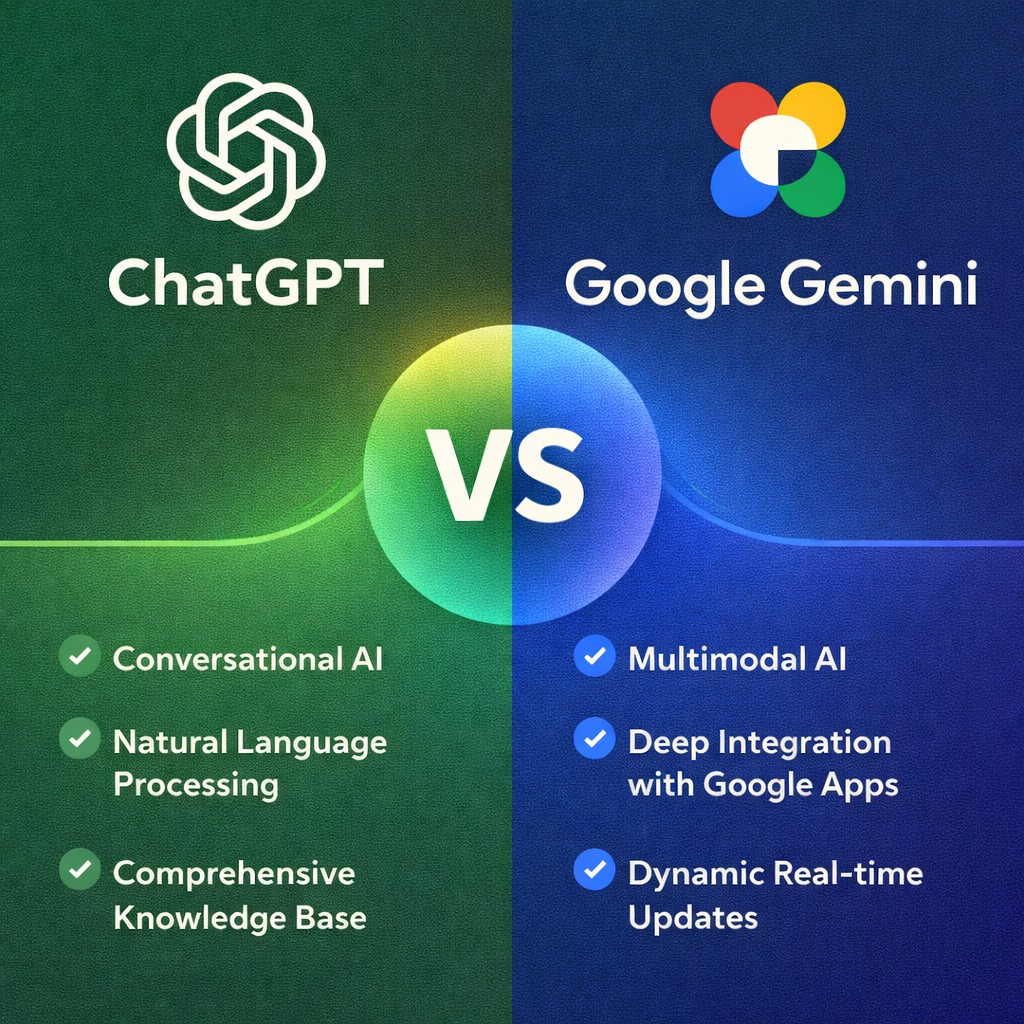
Table of Contents
The Technology Behind the Platforms
Before assessing performance, it’s essential to understand the systems powering each tool. In the debate around ChatGPT vs. Google Gemini for content marketing, their underlying architecture plays a major role in how they behave.
ChatGPT is built on OpenAI’s GPT models, which are optimized for language generation, contextual understanding, and structured writing. It excels at producing human-like text, maintaining tone, and organizing long-form content logically.
Google Gemini, developed by Google, is designed for multimodal intelligence and real-time data access. It is tightly connected to Google Search, YouTube, and Workspace tools, allowing it to draw from current information across the web.
These architectural differences heavily influence how each platform performs in marketing workflows.
ChatGPT vs. Google Gemini for Content Marketing: Core Use Cases
1. Content Ideation and Topic Discovery
When it comes to brainstorming, both platforms are effective—but for different reasons. In ChatGPT vs. Google Gemini for content marketing, ideation highlights a contrast between creativity and immediacy.
ChatGPT is highly effective at generating original topic ideas, campaign concepts, and creative angles tailored to specific industries or brand voices. It thrives when abstract thinking or storytelling is required.
Gemini, on the other hand, leverages real-time search signals. It can surface trending topics, current questions, and emerging user interests, making it particularly valuable for timely, search-driven content planning.
2. Long-Form Drafting and Editorial Flow
Drafting is often the most time-consuming part of content production. In the ChatGPT vs. Google Gemini for content marketing comparison, ChatGPT consistently demonstrates stronger performance for long-form writing.
ChatGPT maintains narrative consistency, follows detailed instructions, and adapts tone with high precision. Many marketers find its drafts require fewer structural edits.
Gemini produces solid drafts but may need additional refinement for voice consistency in longer pieces. Its strength lies more in informational accuracy than stylistic depth.
3. SEO Planning and Optimization
SEO remains central to content success, making it a key battleground in ChatGPT vs. Google Gemini for content marketing.
ChatGPT excels at executing SEO tasks when provided with keywords, such as writing optimized meta descriptions, headers, and structured outlines.
Gemini has a natural advantage in research. Its ability to analyze live search results, identify related queries, and surface “People Also Ask” insights makes it a powerful tool for SEO planning and competitive analysis.
4. Accuracy, Freshness, and Trust
Trustworthiness is critical for brand credibility. In evaluating ChatGPT vs. Google Gemini for content marketing, accuracy is a major differentiator.
ChatGPT relies on its training data and may generate outdated or incorrect facts if not carefully guided. Human verification is essential.
Gemini’s access to live data and source attribution improves reliability, particularly for news-driven or data-heavy content.
Workflow and Integration Considerations
Selecting between ChatGPT vs. Google Gemini for content marketing also depends on how each tool fits into your existing stack.
Gemini integrates seamlessly with Google Docs, Sheets, and Search, making it ideal for teams already embedded in Google’s ecosystem. ChatGPT, meanwhile, offers extensive API support and third-party integrations across CMS platforms, marketing tools, and custom workflows.
Budget, team size, and automation needs should also influence the decision.
The Hybrid Model: Using Both Strategically
For many organizations, the smartest answer to ChatGPT vs. Google Gemini for content marketing is not choosing one, but combining both.
A practical hybrid workflow might look like this:
- Use Gemini for keyword research, trend analysis, and fact validation
- Use ChatGPT for outlining, drafting, and refining narrative flow
- Apply human expertise for strategic direction, brand voice, and final review
This approach maximizes efficiency while maintaining editorial quality.
Conclusion
The comparison of ChatGPT vs. Google Gemini for content marketing reveals two exceptionally capable tools with distinct strengths. ChatGPT excels in creative drafting, structure, and tone control. Gemini leads in real-time insights, SEO research, and factual reliability.
Ultimately, the most effective content strategies do not replace human creativity—they amplify it. By understanding the strengths within ChatGPT vs. Google Gemini for content marketing, marketers can build a scalable, intelligent, and future-ready content engine.