
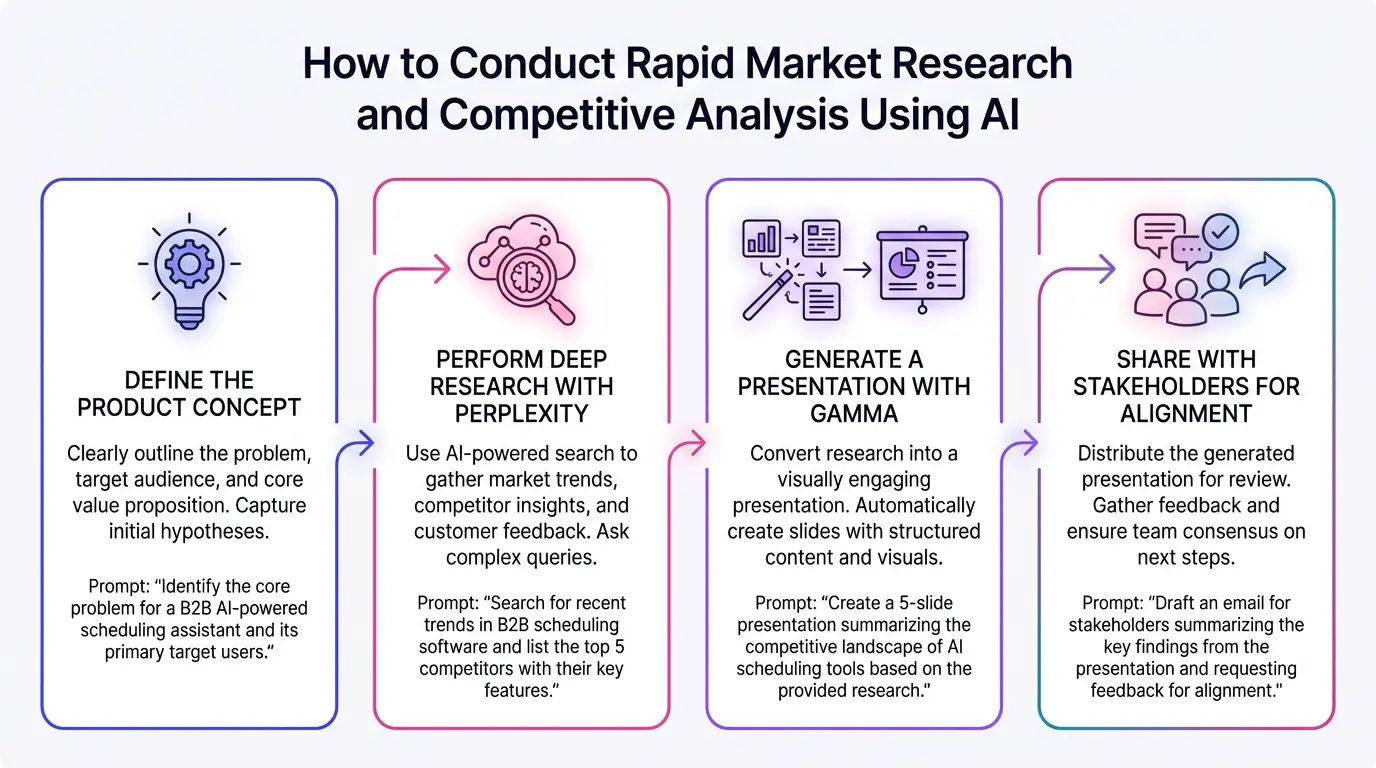
Startups operate in environments defined by uncertainty, limited budgets, and the need for speed. Understanding customers, competitors, and market demand early can be the difference between rapid growth and costly failure. This is where AI-powered market research tools for startups are transforming how young companies validate ideas, discover opportunities, and make data-driven decisions—without the heavy costs of traditional research.
This guide explains what these tools are, why they matter, how startups can use them effectively, and how to evaluate their real business impact.
Table of Contents
Why Market Research Is Critical for Startups
Market research helps startups answer fundamental questions:
- Is there real demand for this product?
- Who is the ideal customer, and what problems do they face?
- How crowded is the competitive landscape?
- What pricing and positioning make sense?
Traditional research methods—surveys, focus groups, consulting reports—are often slow and expensive. Startups rarely have months or large budgets to spare. AI-powered market research tools for startups solve this challenge by delivering faster insights at a fraction of the cost.
What Are AI-Powered Market Research Tools?
AI-powered market research tools use machine learning, natural language processing (NLP), and data analytics to collect, analyze, and interpret large volumes of market data automatically.
They can process:
- Online reviews and customer feedback
- Social media conversations and sentiment
- Search trends and keyword demand
- Competitor content and positioning
- Survey responses at scale
Instead of manually sorting through data, AI identifies patterns, trends, and insights in real time.
Key Benefits for Startups
1. Speed to Insight
Startups need answers quickly. AI tools analyze thousands of data points in minutes instead of weeks.
Example:
A SaaS startup can identify unmet customer needs by analyzing app reviews and forum discussions in a single afternoon.
2. Cost Efficiency
Hiring research firms or buying industry reports can cost thousands of dollars. AI tools dramatically lower this barrier.
ROI impact:
- Reduced research expenses
- Faster iteration cycles
- More experiments with less financial risk
This affordability is a core reason startups adopt AI-powered market research tools for startups early.
3. Deeper Customer Understanding
AI doesn’t just count responses—it understands context and sentiment.
Capabilities include:
- Emotion detection in reviews
- Topic clustering from open-ended feedback
- Pain-point identification at scale
This qualitative depth helps startups design products customers actually want.
4. Competitive Intelligence
AI tools continuously monitor competitors, tracking:
- Messaging changes
- Feature launches
- Pricing updates
- Customer sentiment shifts
This allows startups to respond strategically instead of reactively.
Core Categories of AI Market Research Tools
AI Consumer Insight Platforms
These tools analyze customer conversations across reviews, forums, and social media.
What they do best:
- Identify recurring complaints and desires
- Detect emerging trends before they go mainstream
- Segment audiences based on behavior and sentiment
Startup use case:
Validating a product idea by analyzing existing competitor reviews.
AI Survey & Feedback Analysis Tools
AI enhances surveys by analyzing open-text responses at scale.
Key advantages:
- Automated tagging of responses
- Sentiment scoring
- Theme discovery without manual coding
Startup use case:
Analyzing hundreds of beta-user feedback responses in minutes.
Search & Demand Intelligence Tools
These tools use AI to interpret search behavior and demand signals.
They help startups:
- Discover what people are actively searching for
- Estimate market size through keyword volume trends
- Identify seasonal or emerging demand patterns
This is especially useful during early-stage idea validation.
Social Listening & Trend Analysis Tools
AI-powered social listening platforms track brand mentions, hashtags, and conversations in real time.
Startup use case:
Testing brand messaging by monitoring how users react on social platforms.
How Startups Can Use AI Market Research Across Growth Stages
Idea & Validation Stage
At this stage, the goal is to confirm there’s a real problem worth solving.
AI helps with:
- Market demand validation
- Identifying underserved niches
- Understanding competitor weaknesses
Using AI-powered market research tools for startups here reduces the risk of building products no one wants.
Product Development Stage
Once an idea is validated, AI insights guide feature prioritization.
Examples:
- Analyzing beta feedback to decide what to build next
- Tracking sentiment around new releases
- Identifying usability issues early
Go-to-Market Stage
AI supports messaging, positioning, and pricing decisions.
Use AI to:
- Test different value propositions
- Understand objections and barriers to purchase
- Identify high-intent customer segments
Scaling Stage
As startups grow, market complexity increases.
AI tools help by:
- Monitoring brand health
- Tracking competitor movements
- Detecting shifts in customer needs
This continuous insight loop is a major advantage of AI-powered market research tools for startups.
Measuring ROI from AI Market Research
To evaluate effectiveness, startups should track both hard and soft metrics.
Quantitative Metrics
- Time saved on research tasks
- Reduction in research costs
- Faster product-market fit
- Improved conversion or retention rates
Qualitative Metrics
- Better decision confidence
- Stronger customer alignment
- Improved cross-team communication
The ROI often compounds as AI models learn from more data over time.
EEAT Considerations: Using AI Responsibly
To align with Experience, Expertise, Authoritativeness, and Trustworthiness (EEAT):
Best practices include:
- Combining AI insights with human judgment
- Validating findings with multiple data sources
- Avoiding overreliance on a single dataset
- Documenting assumptions and limitations
AI should enhance—not replace—strategic thinking.
Common Mistakes Startups Should Avoid
- Blindly trusting AI outputs: Always sanity-check insights.
- Ignoring data quality: Garbage in still means garbage out.
- Overcomplicating tools: Start simple and scale usage gradually.
- Skipping action: Insights only matter if they inform decisions.
Avoiding these mistakes ensures startups extract maximum value from AI-powered market research tools for startups.
Future Trends in AI Market Research
Looking ahead, startups can expect:
- More real-time market simulations
- Predictive trend forecasting
- Deeper integration with product analytics
- AI-generated research summaries for leadership
As these tools evolve, early adopters gain a lasting competitive edge.
Conclusion: Turning Insight into Advantage
In today’s fast-moving markets, intuition alone is no longer enough. AI-powered market research tools for startups enable founders and teams to move faster, spend smarter, and make decisions backed by real data—not guesswork.
From idea validation to scaling, these tools help startups reduce risk and uncover opportunities that would otherwise remain hidden.
Call to Action
If you’re building or scaling a startup, start small: choose one AI research tool, apply it to a real business question, and measure the impact. The sooner you integrate AI-driven insights into your decision-making, the stronger your competitive position will be.